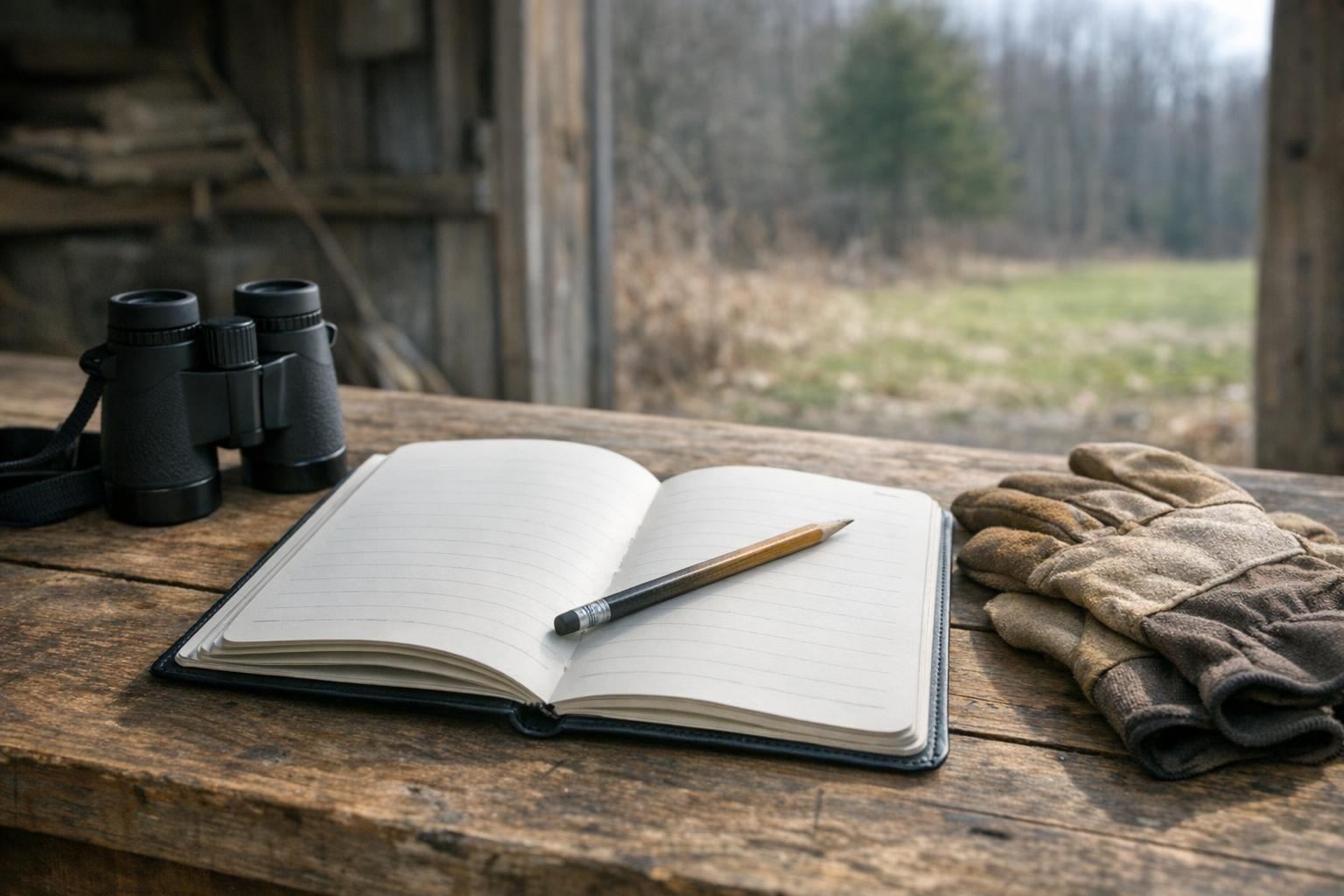
Keep a simple record during the less active months of the year and the fall hunting season will benefit from your efforts. Imagine a family owned property where the owner wishes to improve his fall deer hunting while at the same time look after the land in a sustainable manner. A simple calendar helps to log all your observations and thereby provides the reason for your decisions.
Start with the decisions you want the calendar to support
Decide what you want your calendar to help you with before you choose an app, notebook or spreadsheet. For the family property the property owner has listed the following questions that he wants his calendar to help him with in relation to fall deer hunting. Where do deer travel after a heavy rain? What openings have browse in them? When does the thick cover get so dense that it becomes difficult to move through? Is the access route going to disturb more ground than it needs to?
Identify the key questions for your own use of a calendar, and make sure you record information that can be used later. For example, instead of recording "saw wildlife," record "fresh tracks near the lower crossing after rain." Later you can return to that spot to check for more sign.
You may want to limit the first calendar to around 10 repeatable observations (of course this can be added to at a later date as patterns emerge). For example, animal sign, visible wildlife, food, cover, water, access, and any relevant habitat stewardship work.
Give each season a different job
The first season can focus on very different questions than the late summer scouting trip.
Dormant season – Travel routes to bedding areas, erosion, downed trees, rubs, blocked paths and areas where water stands or flows. Stable items such as fence crossings and swales that hold water regularly should be noted separately from items that will disappear in a short amount of time.
Moving to spring, you focus on the browse, screening cover, any invasive plants that may need control, and how you and your gear move through the property. Later in the season, you simply try to see what the animals see from their favored observation points. In addition, you want to know if it is possible to get through the property quietly when needed.
Use one repeatable route instead of wandering everywhere
Make a simple path of about the same length and in roughly the same direction that includes an edge, some food, some dense cover, some water and the entry/exit points to the property. Stop at 5 points along the route and record the ground, sign of wildlife, cover, human disturbance and any change from previous visits. Use a simple sketch or even a location pin in the notebook to aid in remembering the locations.
You could record the same type of information along a longer route by setting up five or so different 'way points' along the route, recording ground conditions, wildlife sign, cover, human disturbance etc. at each one. It may help to sketch a rough plan of the route between visits and use a location to 'pin' the notebook to that place.
Simply repeated observation of an area does not have to equal constant intrusion into that area's wildlife habitat. Repeated observation of a property from the same edges can be very useful, for example. Be sure to note all visits to a property in your first calendar, and try to keep all subsequent visits on topic as well.
Record conditions, not just animal sightings
Write down as much information as possible about your observation in your notebook, especially about the conditions in which you saw wildlife activity. This includes the weather, ground moisture, the state of vegetation, the time of day, any human activity and how fresh the sign looked.
An example would be to note "deer seen near the field edge" and then "deer seen near the field edge after a wet night; nearby grass was flattened, and the access lane had fresh vehicle tracks" on the following visit. This gives something to test on subsequent visits rather than coming to the wrong conclusion as a result of a single observation.
Keep your observations as simple as possible and avoid speculating. Write "appears recent" or omit altogether if you are uncertain about the age of sign such as animal tracks.
Turn observations into habitat choices
The calendar for your observations is used to help you decide what you should do with your habitat and what you should leave alone. The calendar also helps you to work out what you need to do to improve your habitat and what you need to go back and check on.
If a brushy edge provides cover but the path through it becomes a funnel of tracks into a very narrow crossing, then it is best to keep the cover but alter your route through the area. If a low area holds water repeatedly then look into drainage and soil disturbance before you start to bring in equipment to clear an opening. Also keep a note of how quickly a planned opening becomes overgrown and how this relates to your decisions about screen and cover.
Make a decision and write down the reason for it. For habitat stewardship, it is usually important to realize that there are trade-offs with what you want to achieve. For instance, improving visibility could mean reducing screening cover, and clearing a path through vegetation could mean increasing disturbance. The calendar entries can then help to see what has happened as a result of a decision that was made.
Keep gear modest and the format durable
As far as recording goes, keep it simple and make sure you can continue to use the system after your first few visits out to the property. A small pocket notebook, a pencil, a simple sketch of the property, and a camera on your phone are all you need. Digital notes are searchable which is a big plus over paper, but there is nothing like having a notebook with you at all times – batteries go flat, signal is lost, and it gets cold.
Same headings from visit to visit. Date, Location, Conditions, Observation, Action, Follow-up. Photos have to have a purpose. A photo of a washed-out path is useful to record the state of a track on a property over time. A photo of a changing edge of a woodland is useful to record how a boundary is changing over time. A photo of an unfamiliar plant is useful to have identified.
Trail cameras can provide additional information of wildlife use of your habitat. Use them responsibly, keep the camera in the same location and be aware of property lines and privacy. Be aware of regulations regarding the use of cameras for hunting purposes. Rules can change from year to year and by jurisdiction.
Review the calendar before the next season
Take a few minutes to look back over the seasons before you sit down to start planning again. Remember how many times your routes went through the wettest part of the property? Where did the cover go? Where did the maintenance on your property affect access? Were there a lot of your wildlife observations near roads and field edges? Do you think human activity on your property could be affecting the wildlife?
The example of the family-property may reveal that instead of recording the one time memorable wildlife encounter, the most effective location for an outdoor activity may be that which on repeated visits links food with appropriate cover and a practical and enjoyable approach with minimum disturbance.
Use your past observations to keep your calendar simple by crossing off past observations that helped you make a change on your property, deleting categories that you never use, and adding new questions that you can answer on your next responsible visit to your property. Over time your calendar will become a map of how your property changes due to weather, growth, maintenance and human activity.